
The AI Capacity Backlog
April 23, 2026
The AI Capacity Backlog: Why Encast's Demand-Side Generation Strategy Is Critical to Grid Resilience
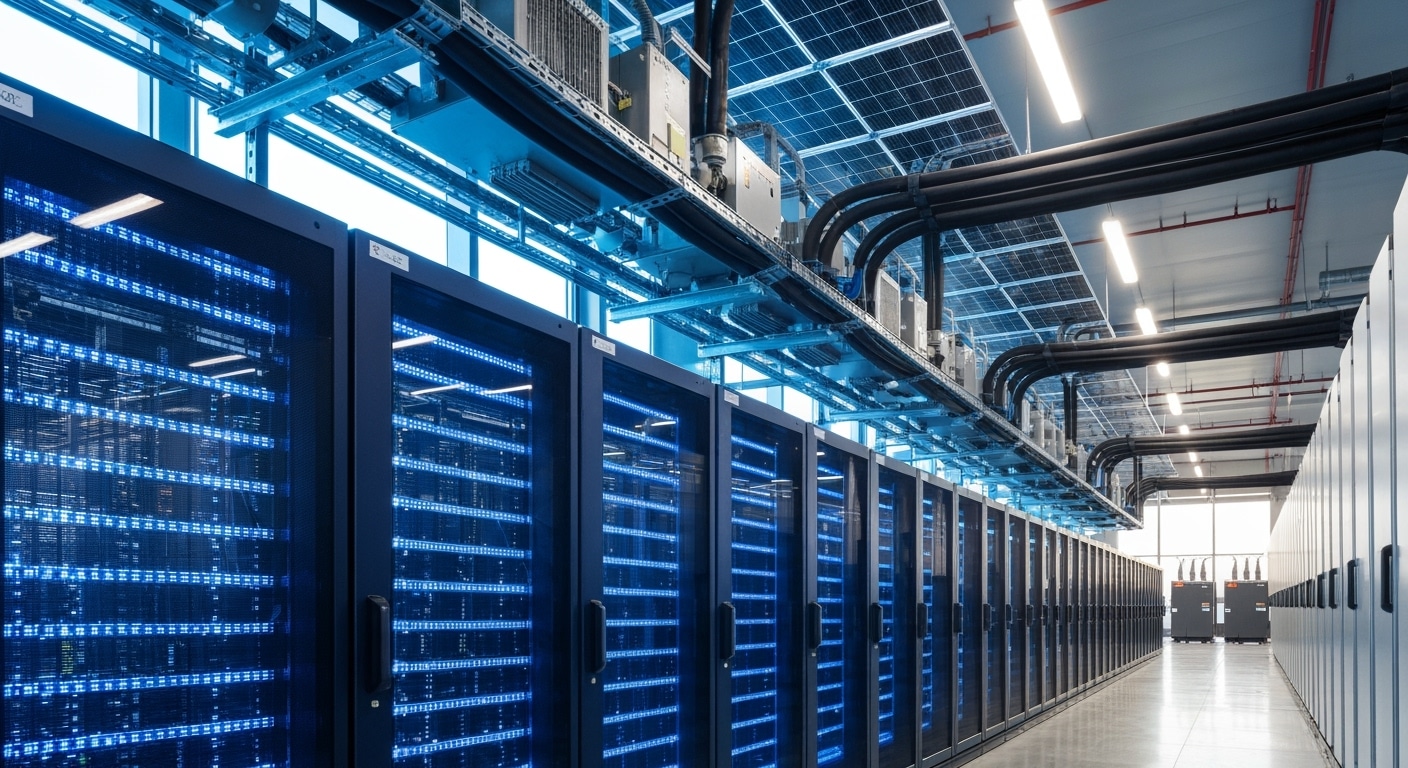
The AI Capacity Backlog: Why Encast's Demand-Side Generation Strategy Is Critical to Grid Resilience
The artificial intelligence industry is engaged in an unprecedented infrastructure buildout, committing hundreds of billions of dollars to datacentre capacity. Yet this expansion reveals a fundamental tension between the speed at which technology companies plan to deploy systems and the physical constraints of electrical grids designed for conventional loads. The result is a looming collision between AI industry expectations and grid reality, one that Encast's demand-side generation framework uniquely positions to address through integrated modelling of resilience, profitability, and long-term grid stability.
The Scale of the AI Buildout
The capital commitment to AI infrastructure is staggering. Microsoft leads with 625 billion in planned investment, of which roughly 45% flows to OpenAI. Oracle follows with 523 billion. These are not marginal additions to existing infrastructure; they represent fundamental reshaping of global datacentre capacity.
The physical manifestation of this investment is equally remarkable: approximately 44 gigawatts of new electrical capacity globally by 2028, according to S&P Global Energy. To put this in perspective, 44 gigawatts slightly exceeds the entire electricity demand of the United Kingdom. A single industry's infrastructure expansion will require generating capacity equivalent to a developed nation's total consumption.
The critical question remains unanswered: how long will this buildout pace sustain? The answer matters profoundly because it determines whether grid operators must plan for permanent baseline load increases or temporary surges that will subside as AI hype cycles run their course. This uncertainty creates precisely the conditions where demand-side generation becomes not merely advantageous but essential.
Hardware and Grid Constraints: The Invisible Bottleneck
The AI buildout immediately encounters severe constraints that reveal fundamental mismatches between industry timelines and physical reality.
Memory chip manufacturer Micron has booking backlogs extending to 2028. Intel CPU shortages, driven by manufacturing bottlenecks and surging AI demand, overwhelm production facilities. DRAM shortages crowd out consumer demand, with companies like Framework struggling to source RAM for consumer products as AI datacentres absorb available supply.
More critical are electrical grid limitations that pose hard physical limits regardless of capital available. S&P Global Energy identifies a 19-gigawatt grid capacity gap; the difference between projected AI demand and available electrical infrastructure capable of delivering that power. This reflects the physical reality that transmission lines, transformers, substations, and generation facilities require years to plan, permit, and construct.
Datacentres preferentially locate in regions with low electricity costs and abundant cooling water, locations that frequently lack grid capacity for hundreds of megawatts of simultaneous demand. The mismatch between where datacentres want to locate and where electrical infrastructure exists creates a fundamental spatial problem that capital investment alone cannot solve.
The Profitability Paradox: When Demand Exceeds Economics
The sustainability of the AI buildout itself faces serious questions that the power industry must urgently address.
Supply chains operate as tubes. If AI demand collapses or decelerates sharply, all hardware in flight must go somewhere, creating stranded assets. A significant portion of AI products remain unprofitable. Sora, OpenAI's video generation system, reportedly lost approximately £15 million daily. If this profitability crisis extends across AI applications, the business model supporting the infrastructure buildout collapses.
More practically, the speed of buildout is unsustainable from grid operator perspectives. Grid operators cannot keep pace with datacentre deployment timelines. There is a critical shortage of qualified engineers to simply deploy electrical equipment, even when available. Grid infrastructure requires meticulous planning, testing, and commissioning; rushing these processes creates reliability risks that grid operators responsible for serving millions of customers cannot accept.
This creates a profound dilemma: datacentres require electrical infrastructure that takes years to build, but investors demand capacity online within months. Traditional grid-dependent strategies cannot bridge this timeline gap. Companies betting their futures on unlimited grid access are betting against physics.
Encast's Demand-Side Generation Framework: Bridging the Gap
This is precisely where Encast's demand-side generation advocacy provides a practical pathway through the paradox. Rather than treating datacentre power supply as a binary choice, grid-dependent or fully autonomous, Encast's modelling framework enables organisations to design hybrid resilience architectures that optimise across multiple dimensions simultaneously: grid utilisation, on-site generation, storage, and flexible load management.
Demand-side generation addresses the timeline mismatch. On-site solar and wind installations can be deployed in months, not years. Battery storage systems paired with renewable generation provide immediate resilience against grid constraints while waiting for grid infrastructure to catch up. Rather than competing with other industries for scarce grid capacity, datacentres deploying demand-side generation reduce their grid draw, freeing constrained capacity for other critical sectors.
The framework enables explicit profitability and redundancy tradeoffs. Organisations can model different scenarios: what is the cost premium for 99.9% uptime versus 99.99% uptime? What battery capacity is required to survive 24 hours of grid outage? What on-site generation mix, solar, wind, or diesel backup, optimises cost while maintaining required redundancy?
These are not questions with single correct answers. They depend on the organisation's risk tolerance, product profitability, regulatory requirements, and geographic location. Encast's integrated modelling enables scenario analysis across these dimensions, allowing organisations to make explicit tradeoff decisions rather than accepting default grid-only configurations by inertia.
Grid Feed and Profitability: The Strategic Dimension
A critical insight that Encast's framework illuminates is the strategic value of maintaining grid connection even while deploying substantial on-site generation. This appears counterintuitive, if you're generating your own power, why maintain grid connection?
The answer lies in the tradeoff between immediate operational needs and long-term financial resilience. During periods of high datacentre utilisation, on-site generation and batteries supply baseload power while the grid handles peak loads. During periods of lower utilisation, inevitable if AI demand proves cyclical, the datacentre becomes a net electricity exporter. Grid feed agreements allow selling excess generation back to the network, monetising idle infrastructure.
This transforms the economics of on-site generation from a pure cost centre into a revenue-generating asset. A datacentre that over-built generation capacity to ensure redundancy can recoup capital investment through grid sales during low-demand periods. In the event of AI bubble deflation, this revenue stream becomes critical to financial survival.
The profitability tradeoff is stark and worth modelling explicitly: a datacentre operating at 60% capacity utilisation with grid feed capability can generate meaningful revenue from idle generation capacity. The same datacentre without grid connection burns capital with no offsetting revenue. Over multi-year cycles, this difference determines whether organisations survive demand collapses or face stranded asset write-downs.
Designing for Redundancy at Scale: The Resiliency Imperative
Encast's framework enables organisations to think systematically about large-scale redundancy and resilience planning, critical for datacentres where unplanned downtime is measured in millions of pounds per minute.
Traditional redundancy approaches treat backup systems as insurance: high capital cost, low utilisation, justified by catastrophic risk mitigation. Encast's modelling enables alternative architectures where backup systems operate continuously, contributing to baseload generation and grid stability services, generating revenue while maintaining redundancy.
A datacentre with 500 MW on-site solar capacity might typically utilise 400 MW during peak AI workloads. Rather than treating the remaining 100 MW as wasted generation, the framework enables explicitly modelling this capacity as: (1) backup power for equipment maintenance, (2) grid stabilisation services providing ancillary revenue, (3) load-shifting capability that enables lower electricity costs during peak pricing periods, (4) geographic diversification of risk if the datacentre operates multiple sites.
The redundancy design process becomes optimisation rather than binary choice. How much on-site generation is necessary? How much storage capacity? What combination of technologies, solar, wind, battery, or diesel generators, provides optimal resilience at minimum cost while maintaining grid connection for revenue and load balancing?
These questions do not have universal answers. Geography, local grid characteristics, AI product demand patterns, and organisational risk tolerance all influence optimal solutions. Encast's integrated modelling enables organisations to model their specific circumstances, exploring the frontier of cost-effective resilience rather than accepting conventional wisdom about acceptable redundancy levels.
What This Means for Grid Operators and Other Industries
Widespread adoption of demand-side generation by AI datacentres has profound implications for grid stability and other electricity consumers.
Grid operators benefit from reduced peak demand. Rather than grids needing to accommodate 44 gigawatts of new datacentre demand through conventional infrastructure, demand-side generation reduces grid dependence. A datacentre meeting 60% of its demand through on-site renewables and storage reduces grid draw from 100 MW to 40 MW. Multiplied across numerous facilities, this dramatically reduces required grid infrastructure expansion.
Other industries face lower competition for limited grid capacity. Manufacturing facilities seeking to electrify industrial processes, hospitals requiring reliable power, and residential consumers all benefit from datacentres reducing grid dependence. This eases the grid capacity constraints that would otherwise force difficult choices about which sectors get priority access to scarce electrical resources.
Grid stability improves through distributed generation. Rather than massive centralised datacentre loads concentrated in specific locations, distributed demand-side generation paired with battery storage provides grid stabilisation services. These facilities can participate in frequency regulation, voltage support, and demand response, providing ancillary services that strengthen overall grid resilience.
Long-term affordability improves. If AI datacentres capture significant grid capacity, electricity prices for other consumers will escalate. Datacentres deploying demand-side generation reduce this pressure, moderating price increases that would otherwise force industrial relocation and residential hardship.
Practical Implementation: The Encast Approach
Encast's advocacy for demand-side generation is grounded in practical modelling capabilities that enable organisations to design resilient systems explicitly.
For datacentre operators, the framework enables integrated scenario analysis:
• Baseline grid-dependent scenario: Model costs and uptime risks of conventional grid-only architecture
• Hybrid demand-side scenario: Model on-site generation, storage, and grid feed opportunities, exploring cost-benefit tradeoffs
• Stress scenarios: Model behaviour during grid outages, extreme weather, or unexpected demand spikes
• Profitability integration: Model revenue from grid feed services, ancillary services, and load-shifting arbitrage
By running these scenarios across different geographic locations, generation technology mixes, and storage configurations, organisations develop explicit understanding of cost-resilience tradeoffs. Rather than designing systems for worst-case scenarios that likely never occur, organisations optimise for their actual risk tolerance and profitability requirements.
For organisations outside the AI industry competing for grid resources, Encast's framework enables similar resilience planning:
• Diversify power solutions combining grid electricity with on-site solar, wind, and storage
• Model time-of-use optimisation to capture value from dynamic electricity pricing
• Plan demand response capabilities that allow temporarily reducing loads during grid stress, earning ancillary service revenues
• Explore hybrid system configurations that minimise total cost of ownership while maintaining required uptime
Physics, Economics, and Resilience
The AI capacity backlog represents a collision between technology industry expectations and physical grid constraints. This collision cannot be prevented through regulatory reform or capital investment alone, it reflects fundamental physics of electrical systems and timelines of infrastructure deployment.
Encast's advocacy for demand-side generation provides a practical framework for navigating this collision. Rather than treating it as a crisis to be endured, organisations can view it as an opportunity to build resilient, economically optimised power systems that provide operational security while generating revenue through grid services and load-shifting arbitrage.
The path forward requires explicit modelling of cost-resilience-profitability tradeoffs that demand-side generation enables. Organisations that understand these tradeoffs and design accordingly will thrive in the AI era, maintaining critical operations during grid stress while monetising generation capacity during periods of lower demand. Those relying on grid-only architecture will face escalating costs, constrained capacity, and vulnerability to the AI boom-bust cycle.
Physics is the ultimate constraint that business cannot negotiate away. But economics offers solutions for those sophisticated enough to model them. Encast's framework bridges the gap, enabling resilience planning at scale in a world where traditional grid assumptions no longer hold.
Ready to build models in real-time?