
The Energy Grid Under Pressure
November 12, 2025
The Energy Grid Under Pressure: Why Infrastructure Modernisation Cannot Wait
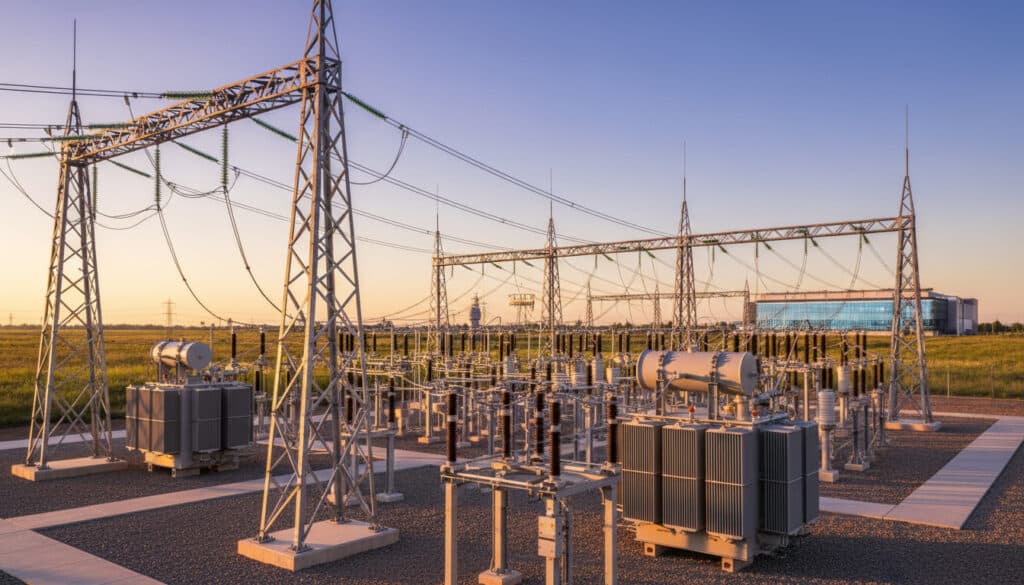
The Energy Grid Under Pressure: Why Infrastructure Modernisation Cannot Wait
The United Kingdom has accomplished more than most nations in developing renewable energy capacity. It has built an advanced, sophisticated power market that has become a model for other countries. Yet beneath this achievement lies a crisis that threatens to undermine the entire energy transition: the grid infrastructure that connects generation to consumption was designed for a world that no longer exists, and demand pressures are mounting faster than the system can adapt.
This is not a uniquely British problem. But Britain's experience offers a clear lens through which to understand the systemic pressures building across developed energy systems pressures that will intensify dramatically over the next decade unless addressed with urgency and investment.
The AI Problem: A Visible Symptom of Deeper Issues
Artificial intelligence has become widely recognized as a primary grid stressor. Data centres running AI workloads consume vast quantities of electricity, arriving with little notice and operating around the clock. This surging demand threatens power quality, with some projections suggesting that AI alone could outstrip grid supply in the United States and United Kingdom within years.
Yet AI is not the root cause of grid stress. It is a visible symptom of something more fundamental: the grid's inability to accommodate rapid changes in demand patterns and supply characteristics.
The mitigation strategies proposed for AI load adjusting compute requests to match grid availability, grid-aware asset management, demand-side generation all point to the same underlying reality. The grid is becoming a constraint on economic activity, rather than an enabler of it. Data centres in some areas must now ask permission from the grid operator before they run their most intensive workloads. This is not a sustainable relationship between critical infrastructure and the digital economy.
Road Transport: Electrification Meets Aging Infrastructure
Road transport remains a huge portion of energy consumption in the West. The shift from internal combustion to electric vehicles represents a rational response to climate change and air quality concerns. But it is creating a cascade of technical challenges that the existing grid was never designed to handle.
Consider the basic physics of EV charging. A single modern fast charger can draw 100+ kilowatts roughly equivalent to 50 typical homes simultaneously. Multiple fast chargers operating in a single location, or a neighbourhood where residents install home chargers, creates concentrated, unprecedented electrical demand that can cause voltage instability in low and medium voltage distribution networks.
The timing problem is worse. In the UK, peak electricity demand historically occurs between 4–9 PM evening hours when people return home and switch on heating and cooking equipment. This mirrors the "duck curve" phenomenon seen in California, where solar generation plummets at dusk just as demand spikes. If EV owners plug in their vehicles during these evening hours, the peak demand becomes unmanageable. The grid must be sized to handle not the average case, but the worst case and the worst case has become substantially worse.
Worse still, EV chargers introduce harmonic distortion into the grid. The switching power supplies in modern chargers generate harmonics at frequencies that can damage other electrical equipment and reduce power quality across the network. Many older parts of the UK grid have minimal harmonic filtering, making them particularly vulnerable.
A fully electric fleet in the UK would require approximately a 46% increase in existing grid capacity a staggering investment that would take decades to deploy even if funding were unlimited.
The mitigation strategies exist. Vehicle-to-grid (V2G) technology allows EVs to both consume and return power, effectively converting millions of vehicles into distributed battery storage. Managed charging where the grid operator coordinates charging times to smooth load could flatten peaks and reduce required capacity. Workplace charging would shift some demand away from evening hours. But managed charging faces significant resistance, particularly in the United States, where consumers resist any hint of external control over when they can charge their vehicles. The politics of rationing electricity are fraught.
Heat Pumps: Shifting Load, Not Reducing It
Heat pump installation is accelerating across Europe as the primary decarbonisation strategy for residential and commercial heating. Heat pumps are indeed more efficient than gas boilers achieving coefficients of performance exceeding 3 in many applications. But efficiency and grid impact are different things.
A crucial misunderstanding underlies much heat pump deployment planning: many policymakers assume that because heat pumps are more efficient, they reduce electricity demand. In reality, they shift demand from the gas network to the electrical grid. A household that previously drew 5 kW of gas for heating now draws 2 kW of electricity a net reduction in primary energy, but a net addition to electrical demand.
In the UK, this shift is creating a new load profile in low and medium voltage distribution networks that these networks were never designed to carry. Where heating was historically distributed across both gas and electrical networks, it is now concentrated on the electrical grid. Peak demand increases occur not gradually, but with steep ramps across the network precisely the kind of rapid demand change that causes voltage instability and equipment stress.
Worse, reversible heat pumps (heat pumps operating in cooling mode during summer) may cause summer demand to increase. Previously, summer demand was low heating was off, cooling was minimal. But as heat pumps become ubiquitous, summer demand may rival winter peaks, eliminating the seasonal variation that has allowed utilities to balance their systems.
The mitigation strategies smart controls, demand response, thermal storage all require investment in control systems and communication infrastructure that most networks lack. Thermal storage (using heat storage tanks or building thermal mass to buffer heat pump operation) could smooth demand, but only if widely deployed and properly coordinated. This is not something that can be done cheaply or quickly.
Decaying Infrastructure: The Silent Crisis
Underlying all of this is a more fundamental problem: much of the UK's electricity distribution infrastructure is aging. Transformers, cables, and protection systems installed 40–60 years ago are reaching the end of their designed life. Replacement is not optional it is essential. Yet the replacement programme is underfunded and slow.
This aging infrastructure is increasingly vulnerable to extreme weather. The UK grid was designed to specifications reflecting historical climate conditions. Modern heatwaves, storms, and freeze-thaw cycles exceed those design assumptions. Heat reduces the capacity of overhead cables and transformers a phenomenon called thermal sagging precisely when demand is highest. Physical damage from storms has become more frequent. Extreme cold can damage equipment designed for milder winters.
The result is a legacy system that is increasingly brittle. It lacks real-time data visibility, creating gaps in grid awareness that make it difficult to mitigate renewable variability. When solar generation plummets unexpectedly, or wind generation surges, the grid operator has imperfect information about what is actually flowing across the network. This drives conservative decisions over-procurement of backup capacity, under-utilisation of renewable sources, or both.
Compounding all of this are connection bottlenecks. The queue for large-scale grid connections in the UK now extends 15 years. A renewable energy developer seeking to connect a wind farm or solar array must wait over a decade for a connection slot. During that time, the project remains unfunded and unbuilt. Some projects are abandoned; others remain in a zombie state consented but not connected, occupying queue positions while never progressing to construction.
This creates a triple threat: rising demand from electrification, insufficient investment in infrastructure expansion, and connection bottlenecks that prevent new generation from being added to the grid. The grid becomes increasingly constrained. Electricity prices rise. Economic activity slows.
A Global Problem with Local Severity
None of these issues are unique to the UK. In fact, many countries particularly in the developing world face far worse conditions. Aging infrastructure is a global phenomenon. The challenge of accommodating rapidly increasing electrification is facing every country pursuing climate goals. The politics of demand management are fraught everywhere.
But the UK's experience is instructive because it illustrates what happens when a wealthy, technologically advanced nation fails to invest systematically in grid infrastructure while simultaneously pursuing aggressive electrification. The solution is not to slow electrification. The solution is to accelerate infrastructure investment.
This means:
- Systematic replacement of aging equipment, not on a reactive basis when failures occur, but on a planned, coordinated schedule
- Deployment of real-time monitoring and control systems that give the grid operator full visibility and automated response capability
- Streamlined connection processes that reduce the queue from 15 years to months
- Investment in distribution network capacity, including underground cabling and transformer upgrades in areas facing electrification stress
- Coordinated planning between electricity, heating, and transport, so that infrastructure is sized for the integrated reality rather than treating each sector in isolation
The cost is substantial. But the cost of not investing is far higher: constrained economic growth, energy poverty, failed climate goals, and a grid that becomes increasingly unreliable as stress exceeds its capacity.
The UK has built world-leading renewable capacity. The remaining challenge is not technical. It is political and financial the willingness to invest in unglamorous, essential infrastructure at a scale that matches the ambition of the energy transition itself.
Ready to build models in real-time?